Physical Address
Los Angeles, CA, United States
Physical Address
Los Angeles, CA, United States

The Pet Tech Gazette | Discover the Future of Pet Tech.
The Pet Tech Gazette | Discover the Future of Pet Tech.

There is a very specific type of anxiety that only a reef aquarium owner truly understands. It usually hits when you are boarding a flight for a week-long vacation. Your mind starts racing: Did the heater get stuck in the ON position? Did the auto-top-off sensor fail and flood the living room? Is the alkalinity dropping? When you have thousands of dollars of sensitive SPS corals and rare exotic fish sitting in a glass box, a simple $15 mechanical failure can wipe out years of hard work overnight.
In 2026, running a high-end saltwater or freshwater planted tank without a smart “brain” is a massive, unnecessary gamble. The market for the best aquarium controller is currently a fierce battleground between the undisputed legacy champion, the Neptune Systems Apex, and the highly innovative, rapidly expanding challenger, the CoralVue Hydros Control X4.
Both of these systems promise to automate your lighting, dosing, flow, and temperature while sending instant push notifications to your phone if anything goes wrong. But after months of running both controllers on two heavily stocked 120-gallon mixed reef systems, dealing with salt creep, power outages, and software updates, the differences in their design philosophies are night and day. Let's dive deep into the hardware, the software, and the real-world reliability of these two aquatic supercomputers.
Before you invest close to a thousand dollars (or more) into aquarium automation, the system must definitively solve the three biggest nightmares of the hobby:
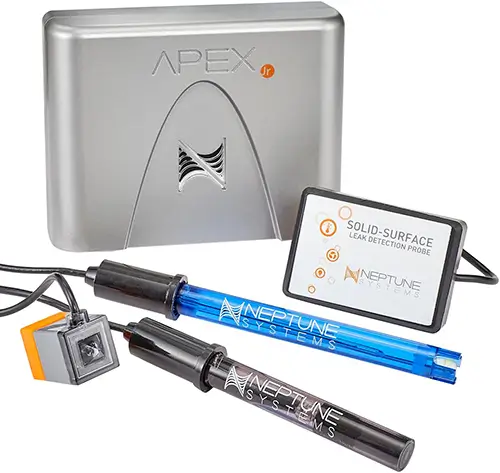
The Neptune Systems Apex is the undisputed heavyweight champion of the aquarium world. If you walk into any high-end local fish store, you will see the iconic orange and grey Apex boards running their display tanks. It has a decade of community trust and the most expansive ecosystem of add-on modules in the industry.
If Temp > 80.0 Then OFF.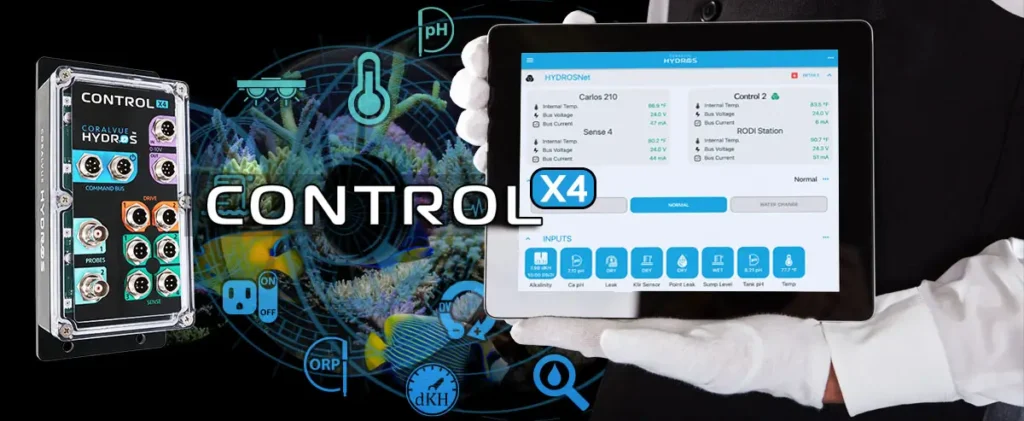
If the Apex is a traditional desktop PC, the Hydros Control X4 by CoralVue is the modern, rugged tablet. Built with an entirely different architecture, Hydros focuses heavily on industrial-grade durability, visual programming, and an incredibly smart distributed power network.
Let’s look at the raw data and technical specifications side-by-side to see how these aquatic brains compare.
| Feature / Metric | Neptune Systems Apex (Pro) | Hydros Control X4 |
| Environmental Protection | Not Waterproof (Keep dry) | IP65 (Dust & Water Resistant) |
| Programming Style | Coding Language + Visual Wizards | 100% Visual Rule-Based App |
| Power Outlet Monitoring | Advanced (Per-Outlet Wattage via EB832) | Basic (Relies on WiFi smart strips) |
| Automated Testing Ecosystem | Trident (Alk, Cal, Mag) | Maven / iV (Multi-parameter testing) |
| Connectors | AquaBus (USB style) + standard plugs | GX12 Aviation Connectors |
| Best Suited For | Advanced DIYers, Data Nerds | Beginners, Moisture-heavy stands |
Hydros completely crushes the competition here. Building a “control board” for an Apex requires extensive cable management, custom cabinetry, and careful routing to keep everything away from water. The Hydros X4 can practically be zip-tied right next to your protein skimmer without fear of corrosion. The aviation connectors give extreme peace of mind.
If you want to do something highly specific—like programming a wavemaker to pulse at a specific frequency only during a lunar eclipse while the feeding timer is active—Apex can do it. The coding language, while intimidating, offers limitless control. Hydros is infinitely easier to set up for 95% of standard reefing tasks, but extreme power users might eventually hit a ceiling with the visual logic blocks.
Both systems will push notifications to your phone flawlessly if the temperature drops or water hits a leak detector. However, the Apex’s ability to send an alert based on power consumption (e.g., a heater pulling 0 watts means the heating element burned out) gives it a slight edge in catching hardware failures before the water parameters actually swing.
Choosing the best aquarium controller ultimately comes down to your technical comfort level and how you plan to build your aquarium stand.
Buy the Neptune Systems Apex if:
You have a massive, high-budget reef tank, you love diving deep into data graphs, and you want the most mature, tested ecosystem on the market. If you want the security of per-outlet power monitoring (the EB832) and the convenience of the Trident water tester, the Apex remains the gold standard for advanced aquarists who don't mind a little coding.
Buy the Hydros Control X4 if:
You want industrial-grade waterproofing, modern aviation connectors, and absolutely hate the idea of writing code. Hydros is the most intuitive, rugged, and fast-growing platform available today. If your sump area is humid, or if you want a modular system that is highly affordable to start and easy to expand visually, the Hydros is an absolute triumph of modern aquarium engineering.
Whichever ecosystem you invest in, having a smart controller will transform your aquarium experience from one of constant anxiety into one of automated stability. Your fish, your corals, and your stress levels will thank you.