Physical Address
Los Angeles, CA, United States
Physical Address
Los Angeles, CA, United States

The Pet Tech Gazette | Discover the Future of Pet Tech.
The Pet Tech Gazette | Discover the Future of Pet Tech.
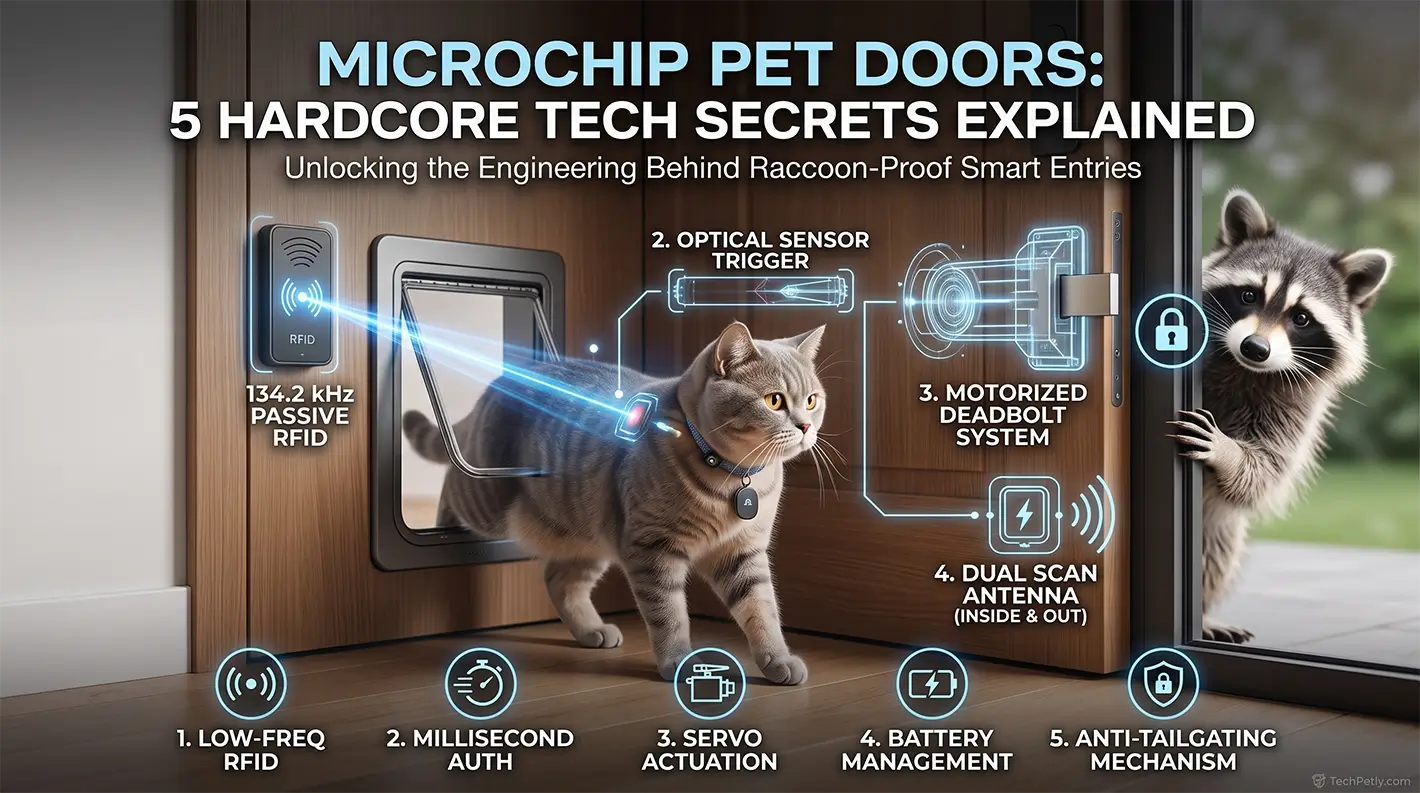
Have you ever wondered what actually happens when your cat approaches, and the flap unlocks in a fraction of a second? The magic behind microchip pet doors isn’t just in the plastic flap itself, but in a sophisticated interplay of passive Radio Frequency Identification (RFID), optical sensing, and electromechanical engineering. For pet owners dealing with intrusive raccoons or aggressive neighborhood stray cats, understanding the physics behind microchip pet doors is crucial before investing in a smart door system.
At the heart of any reliable smart door is passive RFID technology. Unlike a GPS collar that requires constant battery power, the microchip implanted under your pet’s skin (or attached to their collar) has no internal power source. It is completely dormant until it enters a specific electromagnetic field.
Most high-end systems emit a continuous, low-frequency electromagnetic field, typically tuned to 134.2 kHz (the global standard for veterinary microchips). When your pet’s head comes within 4 to 8 inches of the built-in antenna coil, the microchip harvests energy from this electromagnetic field. This momentary burst of power is just enough for the chip to transmit its unique 15-digit identification number back to the receiver.
The security of your home depends on the reaction speed of the internal logic board. The authentication process in modern microchip pet doors happens in three distinct phases:
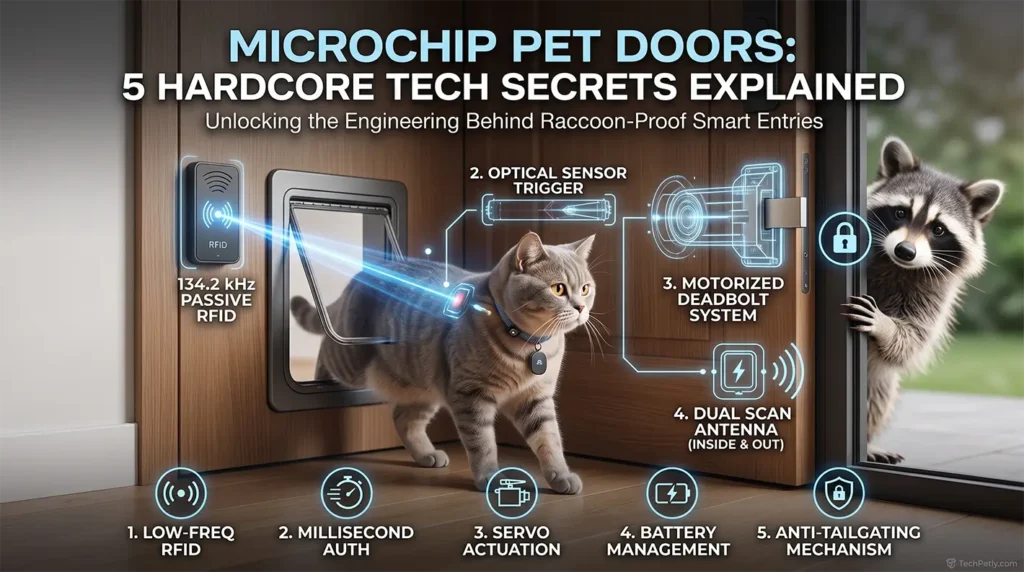
A hidden engineering marvel of microchip pet doors is their power efficiency. Since most of these units run on 4 C-cell or AA batteries, maintaining months of standby time requires hardcore micro-current management.
Engineers achieve this by keeping the main logic board in a deep sleep state, drawing just microamps of current. Only the low-power IR sensor remains continuously active. Once a pet triggers the optical sensor, the system wakes up, performs the high-drain RFID scan, fires the servo motor, and immediately returns to sleep mode. This precise power sequencing is what prevents you from having to change batteries every week.
The biggest pain point for ground-floor homeowners is wildlife intrusion. Standard magnetic flaps are easily defeated by a raccoon's claws. Smart systems combat this through dual-scanning antennas and rigid multi-point locking mechanisms.
“Dual-scan” models feature antennas on both the exterior and interior frames. This allows the system to control not just who comes in, but who goes out—essential for keeping an indoor-only cat safely inside while allowing the family dog to use the yard. Furthermore, high-end models utilize spring-loaded deadbolts that immediately snap back into place the moment the authorized pet clears the optical sensor, effectively blocking any unauthorized animal trying to “tailgate”.
Understanding the mechanics—passive energy harvesting, low-latency microcontrollers, and motorized deadbolts—clarifies why these devices cost significantly more than traditional entryways. You are not just buying a hole in your door; you are installing an automated, biometric security checkpoint.
Interested in upgrading more of your pet's hardware? Check out our in-depth guides on the latest [Satellai Petsense AI Collar & Collar Go In-Depth Review: The Future of Pet Tech?] to build a fully connected ecosystem.